
-
By:
- ophelia
- No comment
palmology pdf
Palmistry, an ancient art, seeks to reveal insights into character and future potential through the study of the hand’s physical traits.
Exploring palmistry involves understanding lines, mounts, and hand shapes, offering a unique perspective on self-discovery and life’s journey.
Numerous resources, including comprehensive guides and PDF materials, are available to begin learning this fascinating practice, offering detailed explanations.
What is Palmistry?
Palmistry, also known as chiromancy, is the art of character reading through the study of the palm of the hand; It’s a practice steeped in history, aiming to evaluate a person’s character or predict their future. The core belief is that the lines and patterns on your palm reflect your personality, potential, and life experiences.
Essentially, it’s a symbolic language etched onto your skin. Understanding this language requires learning to interpret the major lines – the heart, head, life, and fate lines – as well as the minor lines and the mounts (fleshy areas) on the palm. Many introductory resources, often available as PDF guides, detail these elements.
These PDF resources often emphasize that palmistry isn’t about fixed destiny, but rather understanding tendencies and possibilities. It’s a tool for self-awareness and navigating life’s path with greater insight. Learning palmistry involves careful observation and a willingness to interpret the unique map of each individual’s hand.
Historical Roots of Palmistry
Palmistry’s origins are remarkably ancient, tracing back thousands of years. Evidence suggests its practice existed in ancient India, around 3000 BC, and spread to Egypt, Greece, and Rome. Aristotle is even said to have written about palmistry, and it was widely practiced throughout ancient civilizations.
Throughout history, palmistry has been intertwined with astrology and other forms of divination. During the Middle Ages, it faced periods of acceptance and suppression, often linked to religious beliefs. The Renaissance saw a revival of interest in classical knowledge, including palmistry, and numerous texts were produced.
Today, many historical texts and modern interpretations are available, with numerous PDF guides offering a comprehensive overview of its evolution. These PDF resources often detail the cultural shifts and philosophical underpinnings that shaped the practice, demonstrating its enduring appeal across millennia.

The Two Hands in Palmistry
In palmistry, both hands hold distinct significance, offering complementary insights. The dominant hand, typically the one used for writing, reveals the outward expression of personality and life experiences – what you’ve done with your potential.
Conversely, the non-dominant hand reflects inherent qualities, potential, and inherited traits – the blueprint you were born with. It showcases possibilities and predispositions. Comparing both hands is crucial for a complete reading.
Many PDF guides emphasize this distinction, detailing how to interpret the differences and similarities between the hands. These resources often explain that changes in the lines between the two hands indicate how potential has been realized or altered by life’s events. Studying both hands, aided by PDF resources, provides a nuanced understanding.

Understanding the Major Lines
Palmistry centers on interpreting the heart, head, life, and fate lines, each revealing crucial aspects of personality and destiny, as detailed in PDF guides.
The Heart Line
The Heart Line, a key element in palmistry, reveals insights into emotional life, relationships, and overall approach to love and affection. Typically curving across the upper palm, its length and depth offer significant clues.
A deep, clear heart line suggests a passionate and emotionally engaged individual, while a faint or broken line might indicate emotional turbulence or difficulty expressing feelings. The line’s origin – whether under the little finger or towards the index – also holds meaning.
Many palmistry PDF guides emphasize that a line starting under the little finger suggests idealism in love, while a line starting closer to the index finger indicates a more practical approach. Studying variations and branches within the heart line, as detailed in comprehensive palmology PDF resources, provides a nuanced understanding of an individual’s emotional landscape.
Understanding these nuances requires dedicated study, and readily available PDF resources can be invaluable for beginners.
The Head Line
The Head Line, a crucial indicator of intellect, thinking style, and mental aptitude, stretches across the palm, often starting between the thumb and index finger. Its length, curvature, and clarity reveal much about an individual’s cognitive abilities.
A long, straight head line suggests a practical, analytical mind, while a curved line indicates creativity and imagination. A broken or chained head line might signify indecisiveness or scattered thoughts. Detailed palmistry PDF guides often emphasize the importance of comparing the head line to the heart and life lines.
Resources like downloadable palmology PDF documents explain that a deeply etched line signifies strong mental resilience, whereas a shallow line suggests a more sensitive and intuitive nature. Mastering head line interpretation requires careful observation and study, and readily available PDF materials can accelerate the learning process.
The Life Line
The Life Line, often the most prominent line on the palm, curves around the thumb and is frequently misinterpreted as indicating lifespan length. Instead, it primarily reflects vitality, physical health, and significant life events. A long, deep life line generally suggests robust health and a dynamic life journey.
However, breaks or chains within the line don’t necessarily signify illness or premature death; they can represent periods of significant change or challenge. Many palmology PDF guides detail how to accurately assess the life line’s nuances.
Studying downloadable palmistry PDF resources reveals that a faint or shallow line may indicate a more reserved or cautious approach to life. Understanding the life line requires considering its overall quality, depth, and any accompanying markings, offering a comprehensive view of one’s life force and resilience.
The Fate Line
The Fate Line, also known as the Line of Destiny, typically runs vertically up the center of the palm, reflecting the degree to which a person’s life is influenced by external forces and career paths. It doesn’t appear on everyone’s hand, and its absence doesn’t indicate a lack of destiny, but rather greater self-direction.
Detailed palmology PDF guides emphasize that a strong, unbroken Fate Line suggests a life guided by a clear purpose and career trajectory. Conversely, a fragmented or faint line may indicate frequent changes or a lack of clear direction.
Analyzing palmistry PDF materials reveals that the Fate Line’s origin and termination points are crucial. Starting near the wrist suggests early influences, while ending near the Mount of Saturn indicates a life focused on responsibility and achievement. Understanding this line provides insight into life’s influences.

The Minor Lines and Their Significance
Minor lines, detailed in palmology PDF guides, offer nuanced insights into specific aspects of life, complementing the major lines for a complete reading.
Marriage Lines
Marriage lines, typically found on the side of the hand opposite the little finger, are often explored within detailed palmology PDF resources. These lines don’t necessarily indicate marriage itself, but rather significant emotional connections and partnerships.
The number of lines doesn’t equate to multiple marriages; instead, variations in depth, length, and clarity suggest the intensity and duration of relationships. A clear, deep line often signifies a strong, lasting bond, while shorter or fainter lines may represent less impactful connections.
PDF guides often emphasize that these lines should be interpreted in conjunction with other hand features, like the heart line, for a more accurate assessment. Breaks or islands on the marriage line can indicate challenges or disruptions within a relationship, while branching lines might suggest multiple potential partners or a complex emotional life. Careful study, aided by comprehensive palmology materials, is key to understanding these subtle indicators.
Sun Line (Apollo Line)
The Sun Line, also known as the Apollo Line, represents success, fame, and vitality, often detailed within comprehensive palmology PDF guides. It runs vertically up the palm towards the ring finger, indicating artistic talent, creativity, and recognition in one’s chosen field.
A strong, unbroken Sun Line suggests a life filled with achievements and public acclaim. However, its absence doesn’t necessarily mean a lack of success; it can simply indicate that fulfillment is found through different avenues. PDF resources often highlight that a well-defined line appearing later in life suggests success achieved through personal effort.

Variations in the line’s appearance offer further insights. Branching lines can signify diverse talents, while breaks might indicate setbacks or periods of diminished recognition. Studying this line, alongside other hand features using detailed palmology materials, provides a nuanced understanding of an individual’s potential for brilliance and lasting impact.
Health Line
The Health Line, often a subject of detailed analysis in palmology PDF guides, isn’t always present and its interpretation varies. It typically runs horizontally from the base of the palm towards the Life Line, offering insights into vitality and potential health concerns. Unlike other major lines, it’s considered a secondary marking.
A clear, deep Health Line suggests robust health and resilience. However, breaks or faintness can indicate periods of illness or vulnerability. Many palmology resources emphasize that this line doesn’t predict specific diseases, but rather highlights periods where self-care is crucial.
PDF materials often caution against over-interpreting the Health Line, stressing that it should be considered alongside the overall hand reading. A short line might suggest a quick recovery from illness, while a long one could indicate chronic health issues. It’s a valuable indicator, but not a definitive diagnosis.

The Mounts and Their Meanings
Palmology PDF guides detail the mounts – fleshy areas on the palm – revealing personality traits and potential. These areas correlate to planets!
Mount of Venus
The Mount of Venus, located at the base of the thumb, is arguably the most significant mount in palmistry, often detailed extensively in palmology PDF guides. It governs love, vitality, passion, and physical energy. A well-developed and prominent Mount of Venus suggests a warm, affectionate, and sensual nature, brimming with life force.
Conversely, a flat or underdeveloped Mount can indicate a lack of vitality, emotional reserve, or difficulty expressing affection. PDF resources emphasize observing the color and texture; a rosy hue signifies health and passion, while a pale or dry texture may point to health concerns or emotional stagnation. Lines crossing the Mount of Venus can further modify its interpretation, revealing complexities in relationships and emotional experiences. Studying this mount, as outlined in detailed palmology PDFs, provides valuable insights into a person’s core desires and emotional well-being.
Mount of Jupiter
The Mount of Jupiter, situated beneath the index finger, represents ambition, leadership qualities, and a sense of purpose – often thoroughly explained in comprehensive palmology PDF guides. A prominent and well-defined Mount of Jupiter suggests a person with strong self-confidence, a desire for recognition, and natural leadership abilities. Individuals with this characteristic often possess a strong moral compass and a drive to achieve their goals.
However, an excessively large Mount can indicate arrogance or a tendency towards domination, while a flat or underdeveloped Mount may suggest a lack of ambition or self-esteem. PDF resources highlight the importance of observing vertical lines on the Mount, which signify honors and success. Detailed palmology PDFs emphasize that the texture and color also provide clues; a firm texture indicates stability, while a soft texture suggests idealism. Analyzing this mount offers insights into a person’s aspirations and potential for achievement.
Mount of Saturn
The Mount of Saturn, located beneath the middle finger, is deeply connected to responsibility, wisdom, and a serious outlook on life – concepts often detailed within dedicated palmology PDF guides. A well-developed Mount of Saturn signifies a thoughtful, disciplined, and introspective nature. Individuals possessing this trait often exhibit a strong sense of duty and a cautious approach to decision-making.
Conversely, a flat or absent Mount can indicate a lack of focus, impulsiveness, or a tendency towards pessimism. PDF resources frequently explain that lines running through the Mount suggest obstacles or delays in achieving goals, while lines rising towards it signify overcoming challenges. Examining the texture is crucial; a firm texture denotes resilience, while a soft texture suggests sensitivity. Comprehensive palmology PDFs emphasize that the Mount’s position and shape reveal much about one’s karmic path and life lessons.
Mount of Apollo
The Mount of Apollo, situated beneath the ring finger, represents creativity, optimism, and success – themes extensively covered in detailed palmology PDF guides. A prominent and well-defined Mount of Apollo suggests a naturally artistic, charismatic, and fortunate individual. These individuals often excel in fields requiring self-expression and public recognition, displaying a vibrant personality and a positive outlook.

However, a poorly developed or flattened Mount can indicate a lack of confidence, artistic inclination, or difficulty achieving recognition. PDF resources often highlight that lines leading to the Mount signify opportunities for success, while broken lines suggest setbacks. The texture also matters; a fine texture denotes sensitivity, while a coarse texture suggests practicality. Studying palmology PDFs reveals that the Mount’s coloration and overall prominence are key indicators of one’s potential for fame and joyful pursuits.
Mount of Mercury
The Mount of Mercury, located beneath the little finger, governs communication, commerce, and intellect – aspects thoroughly detailed within comprehensive palmology PDF guides. A well-developed Mount signifies a skilled negotiator, possessing sharp wit, and a talent for business. Individuals with a prominent Mount of Mercury are often articulate, persuasive, and enjoy intellectual pursuits, demonstrating a practical intelligence.
Conversely, a flat or underdeveloped Mount can indicate difficulties in expressing oneself, a lack of business acumen, or a tendency towards nervousness. PDF resources emphasize that lines terminating on this Mount suggest financial gain through communication, while broken lines may signify business losses. The texture is also crucial; a soft texture indicates sensitivity, while a firm texture suggests practicality. Detailed palmology PDFs illustrate how the Mount’s position and coloration further refine interpretations of one’s communicative abilities and commercial success.
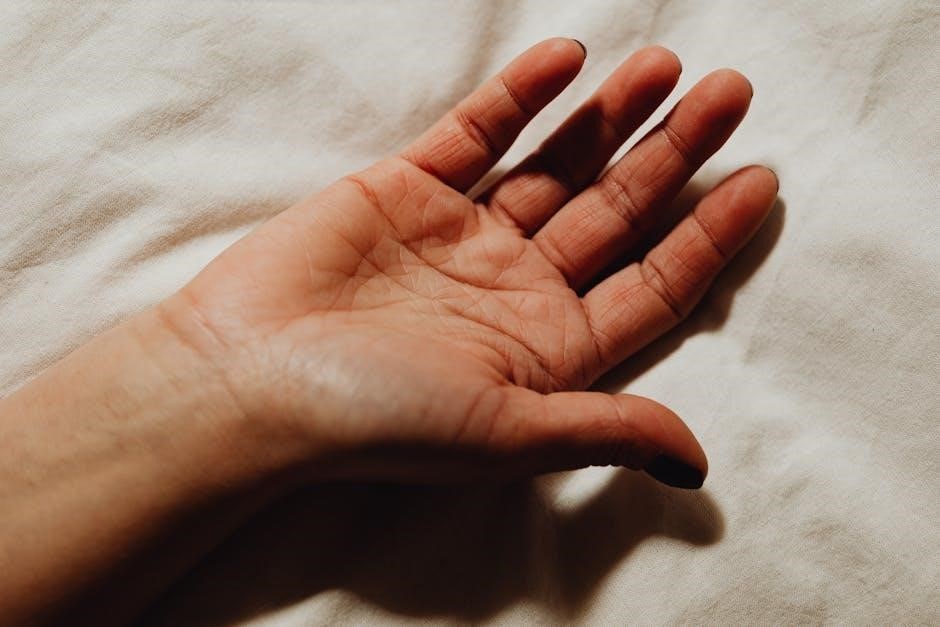
Hand Shapes and Their Characteristics
Hand shapes – Earth, Air, Water, and Fire – reveal core personality traits, detailed in palmology PDF guides, influencing how energy manifests.
Understanding these shapes unlocks deeper insights into an individual’s nature and potential.
Earth Hand
The Earth Hand, characterized by a square palm and thick fingers, signifies practicality, groundedness, and a strong connection to the physical world. Individuals possessing this hand shape are often reliable, hardworking, and possess a natural affinity for tangible results.
Palmology PDF guides frequently detail how the Earth Hand indicates a preference for stability and security, with a methodical approach to life’s challenges. They are not prone to flights of fancy, instead favoring concrete plans and demonstrable achievements;
These individuals thrive in careers requiring precision and dedication, such as engineering, finance, or skilled trades. The skin on an Earth Hand tends to be rough and firm, reflecting their robust nature. Further study within specialized palmology PDF resources will reveal nuances in the mounts and lines, providing a more comprehensive understanding of the Earth Hand’s unique characteristics and potential.
Air Hand
The Air Hand, distinguished by its square or rectangular palm and long fingers, represents intellect, communication, and a lively mental agility. Individuals with this hand type are typically analytical, curious, and excel in fields requiring abstract thought and articulate expression.
Palmology PDF guides often emphasize that the Air Hand signifies a need for mental stimulation and a tendency towards intellectual pursuits. They are natural conversationalists, quick to grasp new concepts, and enjoy sharing their ideas with others. However, they can sometimes be indecisive, overthinking situations before taking action.
Detailed palmology PDF resources will illustrate how the mounts and lines on an Air Hand reveal specific strengths and weaknesses related to communication, learning, and problem-solving. The skin is often dry and cool to the touch, reflecting their cerebral nature and preference for the intangible realm of ideas.
Water Hand
The Water Hand, characterized by its long, oval palm and long, flexible fingers, embodies emotional depth, intuition, and a strong connection to the inner world. Individuals possessing this hand type are often empathetic, artistic, and deeply sensitive to the feelings of others.
Palmology PDF guides frequently highlight that the Water Hand signifies a rich emotional life and a capacity for profound compassion. They are highly intuitive, often guided by their gut feelings, and possess a natural affinity for creative expression. However, they can be prone to mood swings and easily influenced by their surroundings.
Comprehensive palmology PDF resources will detail how the mounts and lines on a Water Hand reveal specific nuances related to emotional intelligence, relationships, and artistic talent. The skin tends to be soft and slightly moist, reflecting their fluid nature and receptivity to emotional currents.

Fire Hand
The Fire Hand, distinguished by a long palm, flushed color, and firm, stubby fingers, signifies energy, passion, and a dynamic personality. Individuals with this hand type are typically ambitious, courageous, and possess a natural leadership quality. They thrive on challenges and are driven by a strong will to succeed.
Palmology PDF guides often emphasize that the Fire Hand represents a powerful life force and a tendency towards impulsiveness. These individuals are enthusiastic, optimistic, and enjoy being the center of attention. However, they can also be impatient, quick-tempered, and prone to burnout if they don’t manage their energy effectively.
Detailed palmology PDF resources will illustrate how the mounts and lines on a Fire Hand reveal specific strengths and weaknesses related to ambition, creativity, and physical vitality. The skin is typically warm and dry, reflecting their fiery nature and energetic disposition.

Resources for Further Learning (PDF Focus)
Palmology PDF guides offer in-depth knowledge, from foundational principles to advanced techniques, enabling comprehensive self-study and skill development for enthusiasts.
Finding Reputable Palmistry PDF Guides
Locating trustworthy Palmistry PDF resources requires careful consideration, as the quality varies significantly. Begin your search on established websites dedicated to esoteric studies or metaphysical knowledge. Look for PDFs authored by experienced palmists with demonstrable credentials or affiliations with recognized palmistry schools.
Online forums and communities focused on palmistry can be valuable sources for recommendations. Seek suggestions from experienced practitioners who can vouch for the accuracy and depth of specific guides. Beware of PDFs offering sensationalized predictions or lacking a solid foundation in traditional palmistry principles.
Reputable guides will typically cover the major lines (heart, head, life, fate), mounts, hand shapes, and minor lines in detail, providing clear illustrations and interpretations. Prioritize PDFs that emphasize a holistic approach, considering the interplay of various hand features rather than isolated interpretations. Always cross-reference information from multiple sources to ensure accuracy and avoid misinformation.
Evaluating the Quality of Palmistry PDFs
Assessing the quality of a Palmistry PDF is crucial for genuine learning. A strong indicator is a logical structure, progressing from foundational concepts to more complex interpretations. Look for detailed explanations of each hand feature – lines, mounts, and shapes – supported by clear diagrams and illustrations.
Beware of PDFs relying heavily on vague generalizations or sensational claims. Reputable guides will emphasize that palmistry offers potential insights, not definitive predictions. Check for a balanced approach, acknowledging the influence of both heredity and environment on hand features.
Consider the author’s background and credentials. A well-researched PDF will often include a bibliography or references to established palmistry texts. Finally, assess the PDF’s clarity and readability; complex concepts should be explained in an accessible manner, avoiding jargon without sufficient explanation.